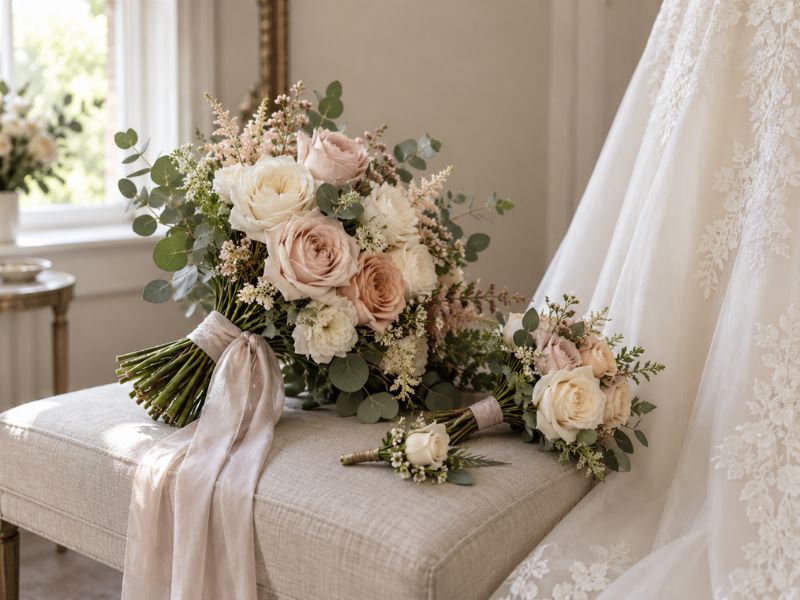
Bridal Bouquets and Wedding Party Flowers
A bridal bouquet is chosen for how it sits against the dress and how long it has to be carried, not just how it photographs. Aisle and Stem designs the bouquet with the bridesmaid flowers, buttonholes and any crowns as one set, so the wedding party matches the ceremony scheme.
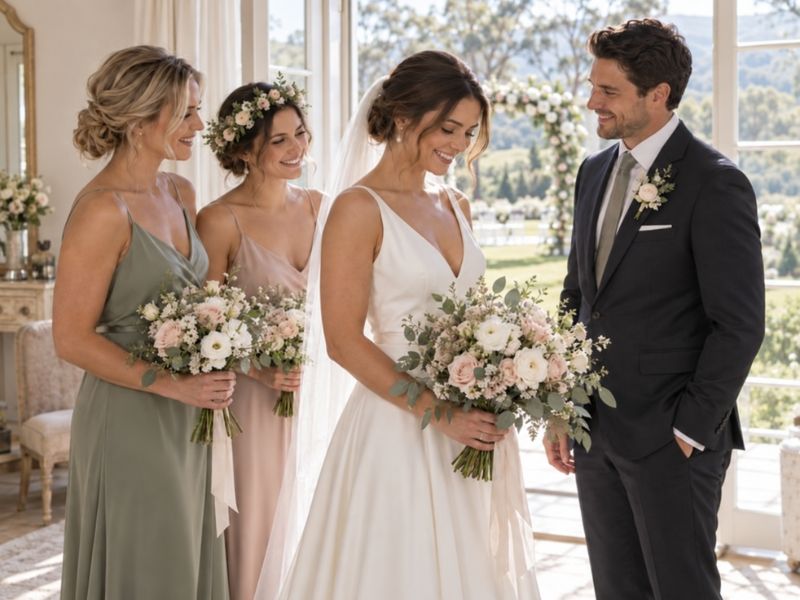
Bridal bouquet shapes and what each one suits
Shape is the first decision and it is mostly about proportion. A bouquet should read as roughly a third of the width of the dress at the point where it is held. Too small and it disappears in photographs, too large and it hides the bodice you chose the dress for.
| Shape | Stem count | Approximate weight | Dress silhouette it suits |
|---|---|---|---|
| Posy | 20 to 30 | 0.8 to 1.2 kg | Fitted, column, slip |
| Round hand tied | 30 to 40 | 1.2 to 1.8 kg | A line, most silhouettes |
| Loose garden style | 30 to 45 | 1.4 to 2.0 kg | A line, empire, relaxed |
| Cascade or trailing | 40 to 60 | 2.0 to 3.2 kg | Ball gown, fit and flare, long train |
| Single stem or small cluster | 1 to 7 | Under 0.5 kg | Minimal, civil ceremony, second look |
Weight matters more than couples expect. A cascade in full water tubes can pass three kilograms, which is a long half hour of photographs after the ceremony. If you want the look without the load, the trailing elements can be built on a lighter frame.
Bridal flowers for the whole wedding party
Bridal flowers means the whole carried and worn set, not only what the bride holds. Designing them together is what makes a wedding party photograph as a group. The usual approach is one dominant variety shared across every piece, with the bride's arrangement holding the widest mix and the buttonholes reduced to the simplest expression of it.
Wedding bouquets by size and stem count
Bridesmaid wedding bouquets are normally built at 55 to 70 per cent of the bride's stem count. That reads as deliberate at the altar without competing. Below half, they start to look like an afterthought in the group shots.
Carrying a wedding bouquet in Australian heat
A February wedding in Perth or Brisbane is a different brief from an August wedding in Melbourne. Above about 30 degrees, soft headed varieties such as garden roses, dahlias and hydrangea start to wilt within two to three hours out of water. For summer dates we build with hardier varieties as the structure and keep the delicate ones for accents, and we ask that bouquets stay in water and out of the car until the ceremony.
Bridesmaid bouquets
The most common request we get is for the bridesmaid bouquet to be a smaller version of the bride's. The more useful version is a simplified one: fewer varieties, same palette. It costs less, holds better through a long day, and stops the group looking like five copies of the same arrangement at different scales.
Buttonholes and corsages
Buttonholes are the item most often forgotten and the one most often damaged. Order two or three spares. Magnetic fixings are kinder to a hired suit than a pin, but they will not hold on a heavy lapel, so tell us the jacket fabric if you can.
Flower crowns for weddings
A flower crown wedding look works best when the crown is built on a flexible base measured to the wearer rather than a fixed circle. For children in the wedding party, we build lighter and smaller than the standard, because anything above about 120 grams tends to be removed before the ceremony finishes.
How stem count and variety change the bouquet
Two bouquets with the same stem count can look nothing alike, because a stem of hydrangea occupies the space of eight stems of sweet pea. What actually decides the finished size is the mix of focal, secondary, filler and foliage.
| Role in the bouquet | Share of stems | Typical varieties | What it does |
|---|---|---|---|
| Focal | 15 to 25 per cent | Peony, garden rose, dahlia, protea | The flowers the eye lands on first |
| Secondary | 25 to 35 per cent | Ranunculus, lisianthus, spray rose, anemone | Carries the palette between the focals |
| Filler and texture | 20 to 30 per cent | Wax flower, thlaspi, sweet pea, grasses | Stops it reading as a solid block |
| Foliage | 20 to 30 per cent | Eucalyptus, ruscus, olive, native foliage | Sets the shape and holds the structure |
A bouquet built with too high a focal share looks expensive and dense but reads flat in photographs. One built with too much foliage looks cheap regardless of what the focals cost. The proportion is most of the craft.
Matching the bouquet to your dress
The rule we use is width. Held at the natural waist, the bouquet should be roughly a third of the dress width at that point. Beyond that, three things matter.
- Detail on the bodice. Heavy beading, lace or a structured neckline competes with a busy bouquet. Simplify the bouquet, not the dress.
- Colour of the fabric. Pure white makes ivory and cream flowers look dirty. Against a bright white dress, either go true white or go clearly coloured.
- Where the waist sits. An empire line raises the hold point, which makes a cascade fall across the skirt rather than below it. Design for the actual hold height, not a photograph of someone else.
If you are worried about the bouquet hiding the dress, a smaller posy carried slightly to one side solves it better than a large bouquet held low, which is the usual instinct and usually wrong.
Flowers for children in the wedding party
Flower girls and page boys are the one part of the wedding party where the design has to account for the wearer rather than the look. Three adjustments make the difference between something that lasts the ceremony and something that is abandoned in the car park.
- Weight. A crown above about 120 grams comes off. Build light, on a flexible base measured to the child rather than to a standard circle.
- Nothing that sheds. Loose petals end up on the floor, on the dress and, if the child is small enough, in a mouth.
- Something to hold, not to carry. A small pomander on a ribbon, a hoop, or a basket works better than a posy, because it survives being swung.
Buttonholes for young boys are best magnetic rather than pinned, and worth ordering two spares, because they are the item most reliably lost between the photographs and the ceremony.
Preserving the bouquet afterwards
Most preservation options need the bouquet within a day or two of the wedding, which means arranging it before rather than after. If you want it done, tell us at the design stage, because some varieties preserve well and others do not.
| Method | Timing | Holds up | Notes |
|---|---|---|---|
| Air drying | Within 48 hours | Roses, lavender, statice, natives, hydrangea | Cheapest. Colour fades but the form holds |
| Silica drying | Within 48 hours | Roses, ranunculus, peony | Better colour retention than air drying |
| Pressing and framing | Within 48 hours | Flat faced flowers, foliage | Suits a selection of stems rather than the whole bouquet |
| Resin setting | Within 48 hours | Individual blooms | Usually a keepsake from a few stems, not the bouquet |
| Freeze drying | Within 3 days | Most varieties | The best result and the most expensive. Specialist service |
Whatever you choose, the bouquet needs to go somewhere cool and out of direct sun the moment the reception ends. A night in a hot car undoes any of these options.
Common questions
How big should a bridal bouquet be?
How much does a bridal bouquet cost in Australia?
When is the bridal bouquet made?
Should bridesmaid bouquets match the bride's?
What holds up best in the heat?
Bouquets are usually briefed alongside the rest of the day. See wedding flowers for the ceremony and reception, and what is in season for your date.
Start with the bouquet
Send your dress silhouette, your date and your colours. We will come back with shapes that suit.