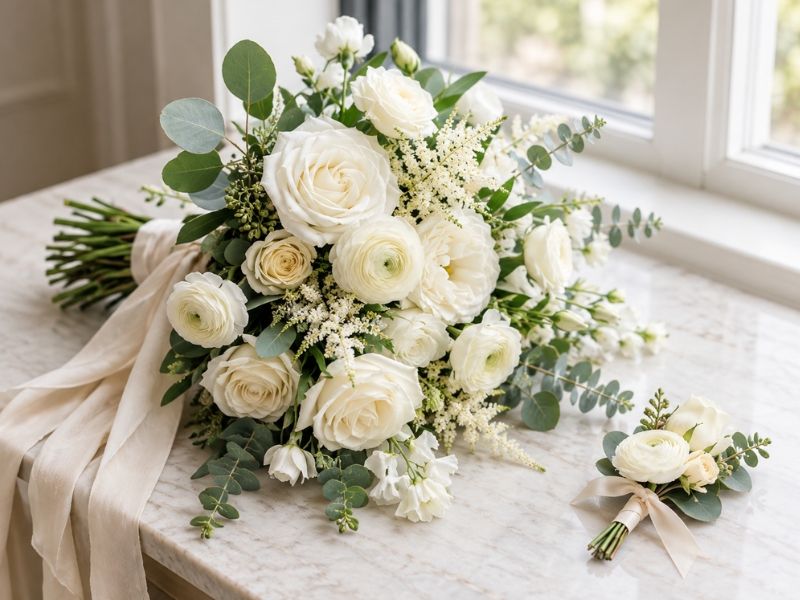
Wedding Flowers, Designed Around Your Day
Wedding flowers cover far more than the bouquet. A typical Australian wedding needs ceremony florals, an arch or backdrop, reception table flowers and centrepieces, plus buttonholes. Aisle and Stem designs the full set as one scheme so it reads as one wedding, not six separate orders.
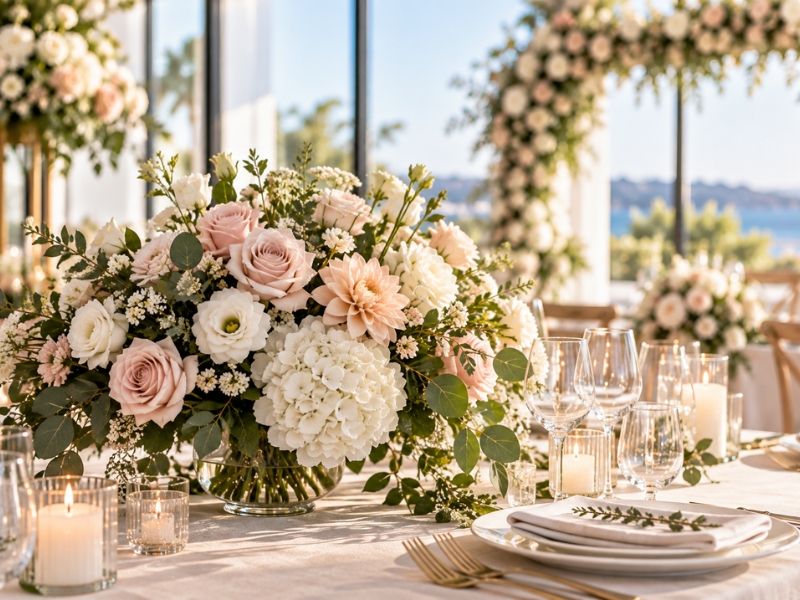
Wedding flower arrangements for each part of the day
Every wedding has three floral moments and they are not interchangeable. The ceremony is seen close up by everyone at once and photographed against the light. The reception is seen for six hours at table height. The personal flowers are carried, pinned and hugged. Designing them together is what stops the day looking assembled from three different suppliers.
| Arrangement | Where it sits | Typical stem count | Install time |
|---|---|---|---|
| Bridal bouquet | Carried | 25 to 45 | Made morning of |
| Bridesmaid bouquet | Carried | 12 to 20 | Made morning of |
| Buttonhole | Lapel | 1 to 3 | Made morning of |
| Ceremony arch | Behind the couple | 150 to 400 | 90 to 180 minutes on site |
| Aisle markers | Chair ends or ground | 10 to 25 each | 30 to 45 minutes |
| Guest centrepiece | Reception table | 15 to 35 each | Placed during turnaround |
| Bridal table runner | Along the head table | 200 to 500 | 45 to 90 minutes |
Wedding floral arrangements by setting
The venue does more to the flowers than the colour palette does. A warehouse with 6 metre ceilings swallows anything under a metre tall. A vineyard marquee moves in the afternoon wind. A heritage room with heavy carpet and dark timber needs lighter tones than the same scheme would need outdoors. We design to the room you are actually in.
Wedding ceremony flowers
Ceremony flowers are on show for twenty minutes and in the photographs forever. That is why they carry more of the budget per stem than anything else on the day. The two decisions that matter are whether the arrangement frames the couple or sits beside them, and whether it can be moved to the reception afterwards.
Wedding arch flowers and ceremony installations
An arch is the single most photographed floral piece at most weddings. It is also the one most affected by conditions: an asymmetric arrangement on an outdoor arch needs weighting against wind, and any fresh installation going up more than three hours before the ceremony needs varieties that hold without water.
Church flowers
Churches usually have their own rules, and they are worth checking before the design starts. Common ones are no fixings to the pews or altar, no flowers left overnight, and a set access window between services. We confirm these with the parish rather than assuming.
Reception flowers
Reception florals do the longest shift of the day. They need to survive being carried in during turnaround, sitting under warm lights for six hours, and being nudged by glassware all night. Sturdier varieties earn their place here even when something more delicate would photograph better.
Wedding table flowers
Table flowers are either low enough to talk over or tall enough to see under. Anything between 30 and 55 centimetres blocks the conversation, which is the most common mistake we are asked to fix.
Wedding centrepieces
Centrepieces are where guest count turns into cost, because they are the one item that multiplies. Ten tables to twenty tables doubles this line and nothing else. If the budget is tight, alternating a full centrepiece with a simpler bud vase arrangement across the tables reads as intentional rather than thin.
Cake flowers, and what is safe on food
Flowers on a wedding cake look simple and are the one floral element with a food safety dimension. Several common wedding varieties are toxic if they contact the cake surface, and not every baker or florist checks.
| Safe to place on a cake | Not safe in contact with cake | |
|---|---|---|
| Common examples | Rose, chamomile, lavender, cornflower, pansy, violet | Hydrangea, sweet pea, lily of the valley, delphinium, ranunculus, calla lily, oleander |
| Why | Non toxic and commonly used on food | Toxic if ingested, or sap that transfers to icing |
| Handling | Stems wrapped, no exposed cut ends in the icing | Use only if fully barriered, or not at all |
The safe method for any variety is the same: wrap the stem, use a barrier or a posy pick, and never push a cut stem directly into icing. If the flowers are unsprayed and edible varieties are specifically wanted, that needs to be specified at order, because standard florist stock is not grown to food standards.
Foliage, and why it decides the look
Foliage is usually a quarter to a third of every arrangement and it is what most couples never mention in a brief. It also does more to the finished character than the flowers do, because it sets the shape.
- Eucalyptus and gum: silver grey, Australian, holds indefinitely, the default for a reason.
- Olive: fine, matte, Mediterranean. Suits vineyards and warm palettes.
- Italian ruscus: dark, glossy, structural. Formal and very hardy.
- Ferns: soft and airy, but they wilt fast in heat and are best indoors.
- Native foliage: texture that no imported greenery matches, and the toughest option in an Australian summer.
- Grasses and dried elements: movement and a modern line, and they cost less than fresh.
If you want a cheaper wedding that does not look cheaper, this is the lever. Shifting the ratio towards good foliage and reducing the focal flower count changes the price more than swapping one flower for another, and it rarely changes how the room reads.
When each arrangement is made and installed
Fresh flowers are perishable, so the running order on the day is not a matter of preference. It is set by how long each piece survives out of water and how long the venue will give you.
- Two days out. Structures, frames and any preserved or foliage base are built in the studio
- Day before. Stems are conditioned: stripped, cut and rested in water overnight. Nothing fresh is assembled yet
- Early morning. Bridal and bridesmaid bouquets, buttonholes and corsages are made and kept in water
- Mid morning. Personal flowers are delivered to the wedding party, in as many legs as there are locations
- Three to five hours before. Ceremony install begins on site, structural pieces first
- Two hours before. Aisle markers, signing table and placed ceremony detail
- One hour before. Final check, water top up, crew clears the space
- During the ceremony. Reception centrepieces and bridal table are placed while guests are elsewhere
- Immediately after the ceremony. Any piece moving from ceremony to reception is relocated
- Same night or next morning. Hired structures and vessels removed, per the venue agreement
Two points in that list catch people out. Personal flowers delivered to two addresses are two delivery legs, not one. And the reception cannot be dressed until the guests have left the room, which is why the turnaround window in your run sheet matters more than the design does.
What is in season for your wedding month
Season decides both what your arrangements can contain and what they cost. Australian seasons run opposite to the northern hemisphere, so saved inspiration from an American or British source is showing you flowers that will be out of season here.
| Your wedding month | At its best | Avoid or expect to import |
|---|---|---|
| December to February | Hydrangea, dahlia, rose, sunflower, natives, gum foliage | Peony after December, ranunculus, anemone, tulip |
| March to May | Dahlia, chrysanthemum, rose, protea, berry and autumn foliage | Peony, tulip, lilac, hydrangea late in the period |
| June to August | Ranunculus, anemone, tulip, hellebore, wattle, blossom | Peony, dahlia, sunflower, hydrangea |
| September to November | Peony from October, garden rose, sweet pea, delphinium, stock | Dahlia early, chrysanthemum limited |
The full picture, including substitutions when the flower you want is out of season, is in our month by month guide to seasonal flowers in Australia.
How many arrangements a wedding actually needs
Guest count sets the centrepieces, and the bridal party sets the personal flowers. Everything else is a choice. These are the counts we see most often, as a starting point rather than a rule.
| Guests | Guest tables | Centrepieces | Personal flowers | Ceremony pieces |
|---|---|---|---|---|
| Up to 40 | 4 to 5, or one long table | 4 to 5, or a 3 m runner | Bouquet, 1 to 2 bridesmaids, 2 to 4 buttonholes | 1 to 2 |
| 40 to 80 | 5 to 10 | 5 to 10 | Bouquet, 2 to 4 bridesmaids, 4 to 6 buttonholes | 2 to 4 |
| 80 to 120 | 10 to 15 | 10 to 15 | Bouquet, 3 to 5 bridesmaids, 6 to 8 buttonholes | 3 to 5 |
| 120 plus | 15 or more | 15 or more | Bouquet, 4 or more bridesmaids, 8 or more buttonholes | 4 or more |
The line that moves most is the centrepieces, because it is the only one that multiplies with guests. If the budget is tight, alternating a full centrepiece with a simpler bud vase cluster across the tables reads as deliberate and typically saves 25 to 35 per cent of that line.
Wedding flowers near you
We design nationally and coordinate a florist local to your venue, so the flowers are made close to where they are needed. Coverage detail sits on the market pages for Sydney, Newcastle, Melbourne, Brisbane, the Gold Coast, the Sunshine Coast and Perth.
Common questions about wedding flowers
How many flower arrangements does a wedding need?
Can ceremony flowers be moved to the reception?
How tall should wedding table flowers be?
When are wedding flowers made?
Are flowers safe to put on a wedding cake?
Every arrangement, one scheme
Tell us the venue and the date and we will design the whole day rather than a list of items.