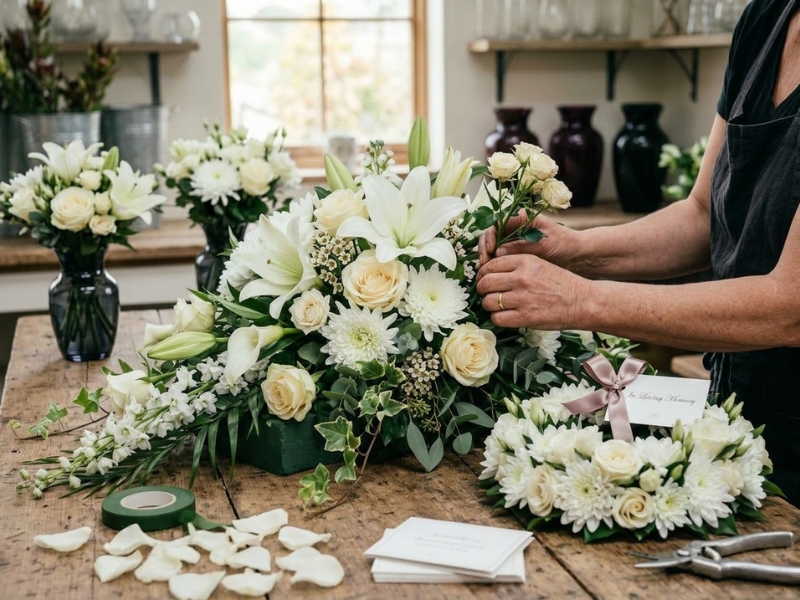
Funeral Flowers, Arranged for the Family
Funeral flowers for the service are usually arranged by the immediate family, separately from the flowers friends send. Aisle and Stem handles the casket spray, memorial and service arrangements, coordinates timing with your funeral director, and can work to short notice.
Family flowers and sympathy flowers are different things. The family arranges the flowers that sit with the coffin and at the service. Friends and colleagues send sympathy flowers to the home or the funeral home. If you have been asked to arrange the service flowers, this page is for you. If you are sending flowers to someone who is grieving, a local florist delivering the same day will serve you better.
Casket flowers and coffin sprays
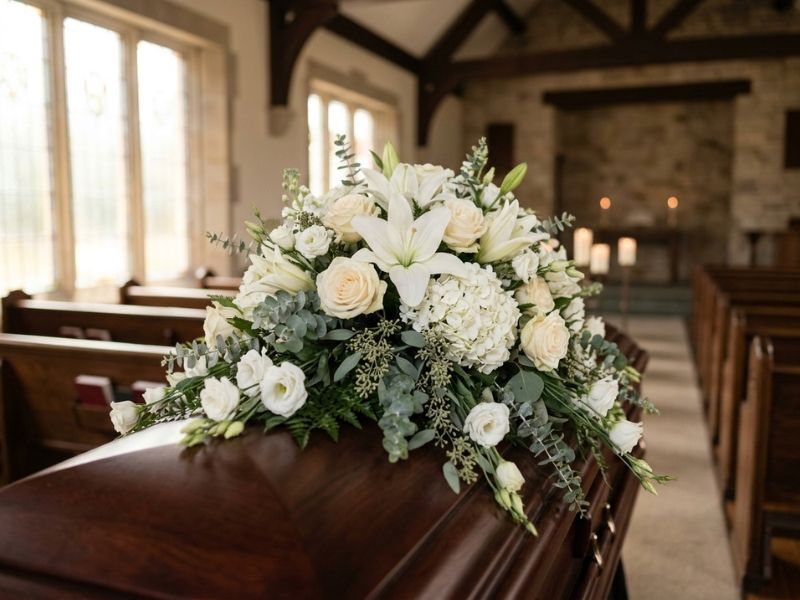
The casket spray is the principal arrangement and the only one built to the dimensions of the coffin itself. A full spray covers most of the lid, a half covers roughly the top third, and a posy sits on a closed coffin at the head. The funeral director will tell us the coffin size and whether the lid is flat or domed, which changes how the piece is constructed.
| Arrangement | Who traditionally arranges it | Lead time |
|---|---|---|
| Casket spray | Immediate family | 24 to 72 hours |
| Coffin posy or cluster | Immediate family, often children or grandchildren | 24 to 48 hours |
| Service or altar arrangements | Family, sometimes the venue | 48 hours |
| Wreath | Family, close friends, associations and clubs | 24 to 48 hours |
| Sheaf or tied bunch | Mourners, to lay at the graveside | 24 hours |
| Memorial or anniversary arrangement | Family, later | Any |
Memorial flowers
Memorial flowers are for services held later, sometimes months after the death, and for anniversaries. There is no lead time pressure, so the design can follow what the person actually liked rather than what is available at 48 hours notice. Families often ask for the varieties from a wedding bouquet or a garden.
Funeral flower arrangements
Beyond the coffin, the arrangements that get used are the ones either side of the lectern, one at the entry, and something at the wake. Most chapels have limited surfaces and a strict turnaround between services, so more pieces than that usually means flowers standing on the floor in the way of the pall bearers.
Funeral wreaths
A funeral wreath is a closed circle on a stand or an easel. It is the traditional form sent by clubs, workplaces and associations, and it is the one most likely to carry a ribbon with a name on it. Standing wreaths need floor space at the front of the chapel, so we confirm with the funeral director how many are already coming.
Choosing flowers for a funeral
There is no rule you have to follow. White is conventional and always correct. Colour is increasingly common and often truer to the person. If the family has a cultural or religious tradition, tell us and we will work within it. If nobody can decide, the useful question is not what is appropriate but what did they grow, wear or notice.
Short notice, what is possible inside 48 hours
Most Australian funerals are held five to ten days after the death, but the flowers are usually confirmed in the last two or three days. Inside 48 hours we can generally deliver a casket spray, a wreath and service arrangements using what is at market that morning. What we cannot do at that notice is import a specific variety or match an exact colour. Tell us the constraint and we will say plainly what is achievable.
Working with a funeral florist
We speak to the funeral director directly so you are not passing messages. They confirm the chapel, the service time, the access window and the coffin dimensions. You confirm the flowers. That is the whole division of labour, and it removes the most common failure, which is flowers arriving after the previous service has already been cleared.
Personalising the flowers
The families who find this part easiest are the ones who stop asking what is appropriate and start describing the person. Almost anything can be built into a floral arrangement if we know about it early enough.
- What they grew. Roses from a garden, camellias from a hedge, herbs from a vegetable patch. Cut stems from the family garden can be incorporated into the casket spray if they reach us the day before.
- Their colours. The football team, the club, the flag of where they were born.
- What they wore. A ribbon from a hat, a length of fabric, a tie, worked into the binding.
- Where they were from. Native varieties for someone who spent their life in the bush read very differently from imported roses.
- What they did. Wheat and grasses for a farmer, olive and rosemary for a cook, driftwood and coastal foliage for someone who lived by the water.
None of this needs to be explained to anyone at the service. It is for the family, and the people who need to notice will.
What each arrangement costs to have made
Funeral flowers are commonly arranged in a difficult week, and nobody wants to negotiate. These are indicative Australian ranges so you know what to expect before you speak to anyone.
| Arrangement | Typical range | What moves it |
|---|---|---|
| Casket spray, full lid | $400 to $900 | Coffin size, variety choice, season |
| Casket spray, half lid | $250 to $500 | As above |
| Coffin posy or cluster | $90 to $200 | Size and whether it is one piece or several |
| Standing wreath on an easel | $150 to $350 | Diameter and density of coverage |
| Service or altar arrangement | $120 to $300 each | Height and the venue's own restrictions |
| Sheaf or tied bunch | $70 to $160 | Stem count |
| Memorial or anniversary arrangement | $90 to $250 | Design and whether varieties are in season |
| Delivery to chapel or funeral home | $40 to $120 | Distance and time window |
Reviewed September 2026. These are indicative ranges for the Australian market, not quotes. Short notice and out of season varieties sit above them.
Working with the funeral director
We deal with the funeral director directly, which removes the most common failure: flowers arriving after the chapel has already been cleared for the next service. Six things get confirmed, and none of them need to come from you.
- Coffin dimensions and whether the lid is flat or domed, which decides how the spray is built
- Chapel or church, the service time, and the delivery window before it
- What surfaces exist at the front, and how many standing pieces the space will hold
- Whether flowers travel to the graveside or crematorium, or stay at the chapel
- What happens afterwards: taken home by the family, left at the grave, or donated
- Other arrangements already coming, so the chapel is not overfilled
That last point matters more than people expect. A workplace, a sporting club and an extended family all sending standing wreaths to a small chapel creates a problem that somebody solves at the door, badly, ten minutes before the service.
Flowers after the service
Deciding this in advance is a kindness to whoever would otherwise decide it on the day. The usual options are that the family takes the arrangements home, they go to the graveside, or they are donated to a hospital, aged care home or hospice, which many funeral directors will arrange.
If the casket spray is going to the graveside, it needs to be built to be lifted and carried by two people rather than to be seen from the front only. Tell us and we will build it that way.
Common questions
How quickly can funeral flowers be arranged?
Who arranges the flowers on the coffin?
What do funeral flowers cost in Australia?
Can flowers be arranged if the family has asked for donations instead?
Do you coordinate with our funeral director?
Funeral flowers near you
Arrangements are made by a florist local to the chapel or church, because delivery windows for funerals are narrow and non negotiable. We coordinate that in every market we cover.
We can work to short notice
Tell us the date, the chapel and the funeral director. We will take it from there.